Type Faces: Meet Dan Rhatigan.
Spotlights
Spotlights
Type Faces: Meet Dan Rhatigan.
Welcome to our Type Faces series, where we’ll be sharing the stories of some of the fabulous people behind the type here at Monotype. From all around the globe and across the organization, our Monotype colleagues truly prove that, like Charles Nix, Senior Executive Creative Director at Monotype, always says, “We are ALL creative.”
A self-described “huge type nerd,” Dan is a longtime type designer, educator, historian, publisher, and collector with a fondness for fading and obsolete typographic technologies.
Now, as Senior Creative Foundry Director at Monotype, Dan combines his deep historical curiosity with a commitment to stewarding the future of type: connecting makers and foundries, empowering type communities, and proving through his creative work that even the most antiquated lettering systems still have new stories to tell.
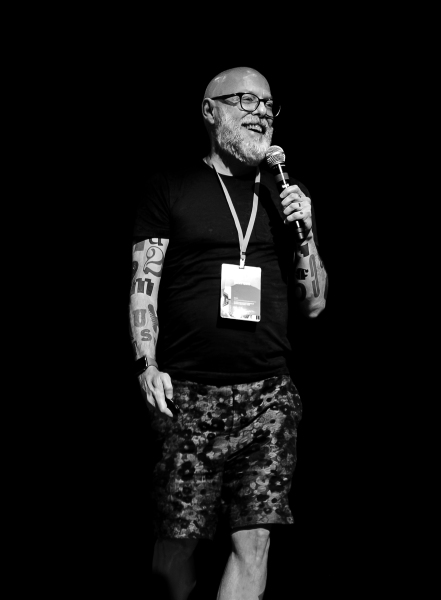
Dan Rhatigan presenting at DiaTipo in December 2024.
Who or what inspires you in life?
I get a real kick out of seeing people use type in ways I never would. It’s beautiful and exciting and makes me want to contribute to that ecosystem. I’m also especially energized by traveling, which lets me see cool and interesting things in more places.
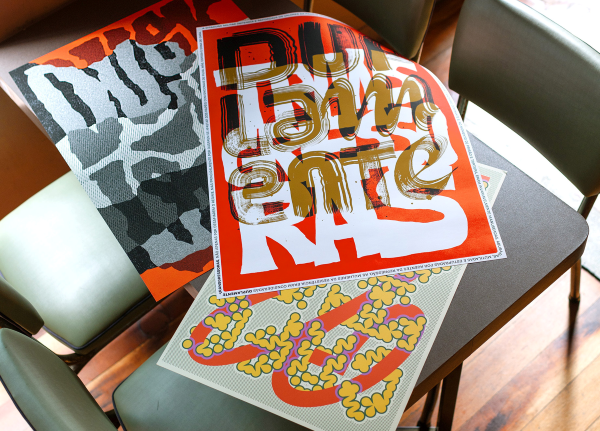
Posters by Brazilian designer Cyla Costa — examples of type used in innovative ways.
I’ve also always loved seeing people do creative things with outdated technology. I know a lot of letterpress printers and, while I don’t do much myself, I love how they push old equipment in new directions. I have a temperamental Risograph printer at home. It’s fun to see what creative work can come from old office machines.
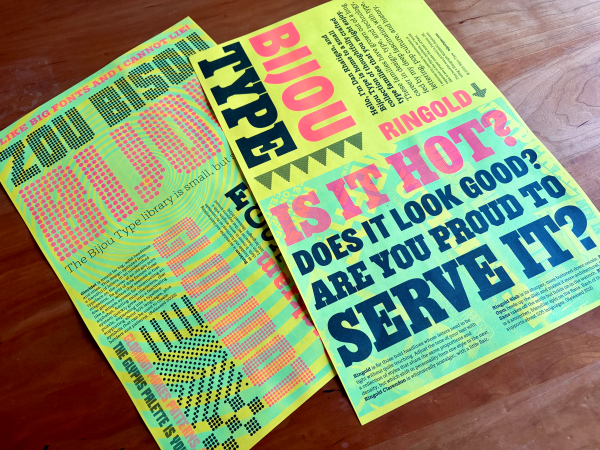
A Bijou Type specimen, one of Dan’s own creations, printed with risograph.
What personal creative pursuits are you most passionate about?
I’ve been publishing a zine called Pink Mince for 16 years now. It’s my arty queer zine — a mix of photography, typography, storytelling, and illustration. It’s a space where I can cut loose and follow my interests wherever they lead. Secretly, I think of it as a type magazine with cute guys.
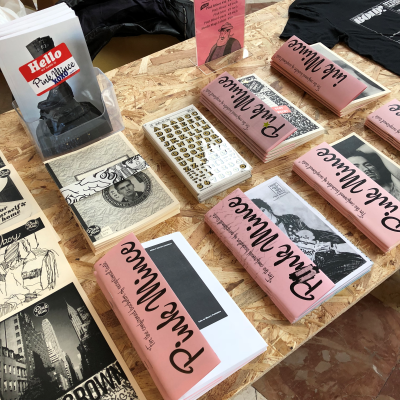
Issues of Pink Mince for sale at the Fruit Exhibition independent art book fair in Bologna.
Pink Mince gives me a reason to make things, to bring my art to new places and new people. Type can be a solitary pursuit, and I work remotely, so it’s important to have something that connects me with other artists and designers. Recently, I attended an art book fair at the KANAL-Centre Pompidou in Brussels — the Brussels Ass Book Fair, part of the Paris Ass Book Fair network— and also spoke at a panel discussion about zines in Amsterdam.
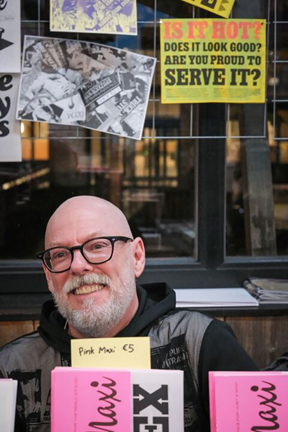
Brussels Ass Book Fair © Veerle Vercauteren / KANAL-Centre Pompidou
The fair was a pretty big success! Around 2,500 people passed through over the course of the weekend, and I had lots of fun conversations with people who had never seen my zines before but really appreciated what I had done. It was especially nice to see some people I had met in Brussels turn up for our small but enthusiastic zine panel in Amsterdam the following week, eager for more advice about how to start self-publishing their own projects.
What do you find interesting about typography?
I got into type through the high school newspaper. I was drawing cartoons and I had to set the headlines using rub-down transfer type or headline machines where you could change the font style. That’s when it clicked for me: the idea that a typeface changes the personality of what you’re saying. It’s been compelling ever since.
Type is so subjective, and it’s an abstract ingredient that can shape communication in powerful ways. It became the part of graphic design that I felt most drawn to. Type and design are my artist’s medium and the lens through which I interpret the world around me.
What’s a font you love and why?
Right now, I have to say that my own Bijou type families are my favorites because I’ve been spending a lot of time with them, testing them out to see what they’re good for and what they struggle with.
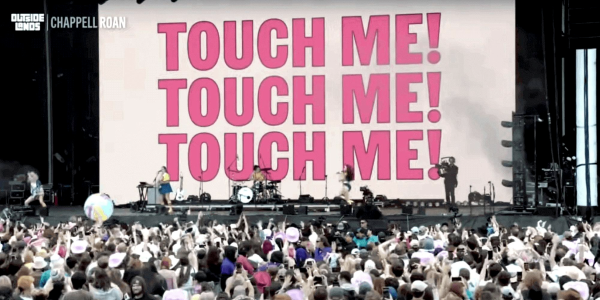
Amazon Music Outside Lands Festival 2024 live stream, featuring Ringold Sans, a Bijou typeface. Source: Amazon Music, retrieved from the official festival live stream.
For me, type inspiration always comes from determining what I can’t do with the tools at my disposal and then figuring out what I can make that fills those gaps.
What’s a creative experience you think everyone should have?
I’m a huge booster of Tipoteca Italiana, a printing museum in Italy. I lead a creative residency there every summer along with a couple of friends. We bring designers and printers together to experiment with historical materials through library visits, walking tours of Venice, and hands-on workshops. It’s a really intense, joyful way to engage with the history of type and digest it through play, and kind of a concentrated version of my own process of observing the world and making things. I interviewed the curator on a recent episode of Monotype’s Creative Characters podcast — listen to it to learn more about what this magical place is about.
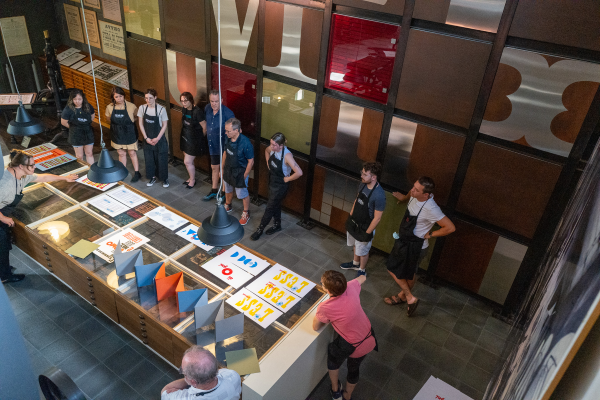
Residents reviewing work at Tipoteca Italiana.
Also, I think everyone should check out their local zine fairs. They’re full of people creating for the love of it, pushing things into the world just because they want to. You’ll find students, young professionals, and other folks doing work that doesn’t fit in with mainstream publishing. That’s where interesting things are really happening.
Is there anything you like to collect?
I have a vast collection of Letraset dry-transfer lettering sheets that graphic designers used for decades. It went from being everywhere to obsolete overnight once computers came on the scene. There are only a few artists out there using it, like Chris Ashworth.
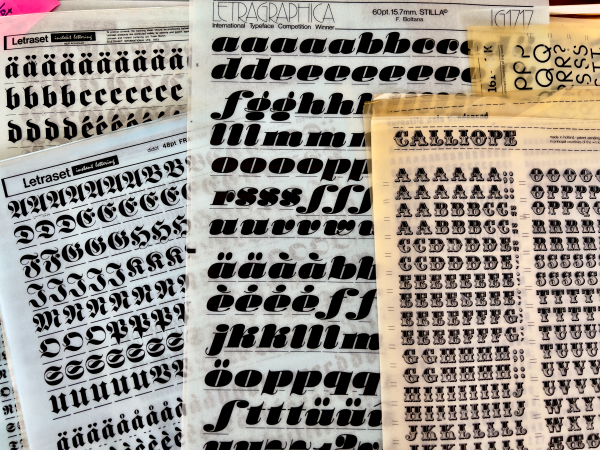
Examples of dry transfer type from Letraset and other brands.
I got into collecting these materials when researching how zines were made. I ended up buying thirteen crates from an art supply store going out of business, and I’ve been gathering other specimens since then. I’ve done student workshops with it, and I sell sheets to folks who want to make cool stuff — like restoring logos on vintage audio gear or designing cassette labels.
Aside from what I’m using or selling, I’m working on putting together one pristine copy of every typeface, in every size, so I can donate the collection to the Letterform Archive in San Francisco. If I’m going to be deep in this, I might as well go all in.
What’s your history with Monotype?
I first joined Monotype in 2008, initially as a researcher embedded from the University of Reading, focused on non-Latin type. Then I became a type designer, shadowing Robin Nicholas and eventually taking over for him as UK Type Director. I left in 2015, feeling burned out, but returned in 2024.
What brought me back was a chance meeting with Monotype’s executive team at the Museum of Printing in Haverhill, MA. I was there doing research; they were there for an offsite. I ended up talking with the CEO, Ninan Chacko, and the others about where Monotype was headed. It seemed like the company had changed a lot and this felt like a good time to come back and do meaningful work.
I just started a new role as Senior Creative Foundry Director on the Creative Services team. When I first came back to Monotype about a year and a half ago, I worked on inventory strategy — looking at our whole library, identifying gaps, figuring out how to fill them, and curating type collections.
What do you love about your job?
I’m excited to work more directly with customers again. In Creative Services, I get to collaborate with partners and create new opportunities for people making type. I still work with external foundries, which I love. There’s a broader perspective now at Monotype than there was during my first stint here.
There’s something Ninan has said that’s really stuck with and guided me: “Something’s only good for Monotype if it’s good for the whole industry.” That shift in thinking really matters. Type is so important to me, and I want that enthusiasm to be infectious. I’m in a role now that really allows me to evangelize for type.
One of the things I’ve loved about this career — and especially my work at Monotype — is the opportunity to travel. I’ve been really lucky that my job keeps putting me in touch with interesting places and people.
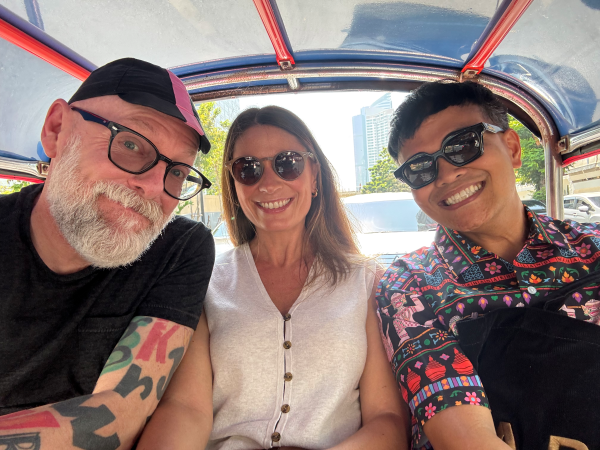
Dan, Candice Smith, and Romeo Ruz in Bangkok, Thailand for the Brand Identity and Typography Symposium (BITS) in February 2025.
What’s something that would surprise people about you?
I’m extremely shy. People see me give talks or lead things at work and think I’m outgoing. But socializing wears me out. Mingling at a cocktail party? It almost gives me a panic attack. If I’m speaking at a conference, I’m basically overclocking the whole time. I need a lot of quiet time alone to recharge and be myself again.
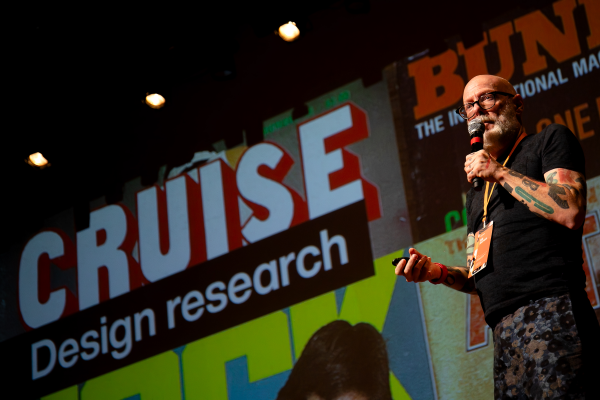
Dan presenting at DiaTipo in São Paulo, Brazil in December 2024.
I think all the salespeople who I’ve worked with at Monotype over the years have learned a very important lesson about me, which is that when we’re at events together, I definitely want to be invited to the drinks and the dinners so I feel included, but they never actually have to leave room for me on the reservation.
When you’re not traveling, where is home?
After getting through the pandemic in a tiny New York City studio, I needed more elbow room and some trees. I moved to Portland, Oregon — mild climate, good food, walkable city, and I finally have a proper studio space.

Dan at home with BB and his books.
It really feels like the universe wanted me to land in Portland and build a life here. For example, I’ve met a surprising number of other type people living right in my neighborhood — a friend who’s a design educator and graphic designer, an engineer from Apple’s fonts team, someone who’s worked at both Adobe and Extensis. I even met a sign painter who’s now a tattoo artist and looking for people who want lettering tattoos to help him practice that skill. My partner and I have made new friends and adopted a dog. We took a chance, and it’s really paid off.

Senior Creative Foundry Director
Dan Rhatigan.
Dan Rhatigan is Senior Creative Foundry Director at Monotype. Based in Portland, Oregon, he has decades of specialized experience in design and typography. He now works as part of Creative Services, looking after Monotype’s design collaboration with our foundry partners.