What happens when you use unlicensed fonts?
It’s invisible until it isn’t.
Using a font without a valid license exposes an organization to real legal, financial, and security risk — even when the use was accidental. Font software is protected intellectual property, licensed under an end-user license agreement (EULA), not sold outright. When a font is used outside the terms of that agreement, the organization using it is exposed, regardless of intent.
Most teams don’t set out to use a font they haven’t licensed. It happens quietly, in the middle of getting something else done: a “free fonts” site bookmarked at 11 p.m. before a pitch, a template inherited from a designer who left the company, a file an agency partner forwarded without a license attached. The font renders. The deck looks sharp. Nobody stops to ask where the file actually came from — because nothing about it looks wrong.
That’s what makes unlicensed font use different from most creative mistakes. It’s invisible until it isn’t.
A font license tells you how to use a font.
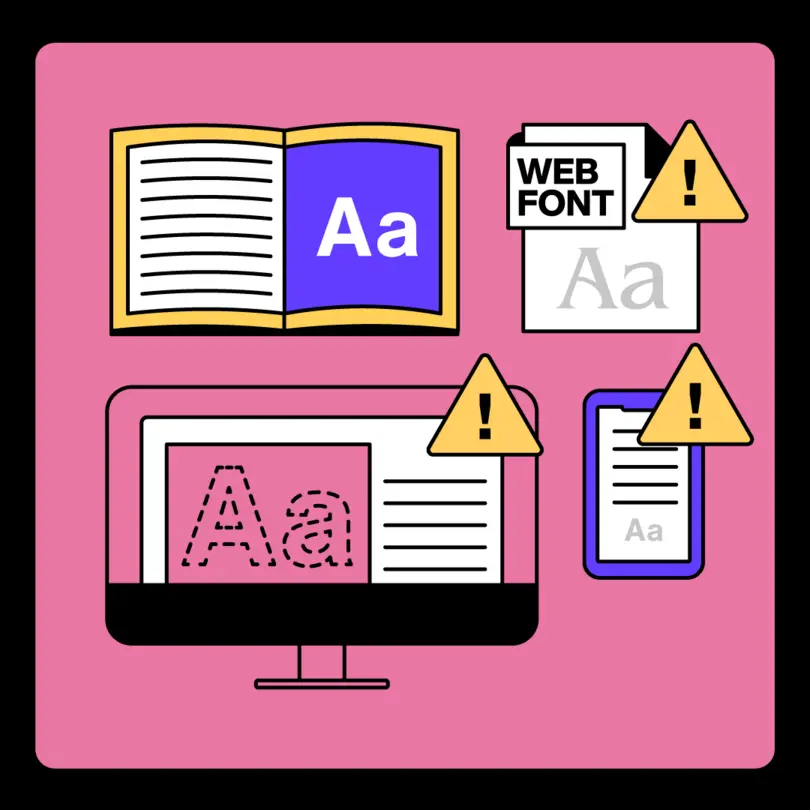
A font license reads like a simple document: install on this many machines, embed on this many pages, use for this kind of project. In practice, however, there’s more going on than meets the eye. Font Licensing Guide breaks a single typeface into desktop, web font, digital ad, mobile app, ePub, and server licenses — each covering a different application, each with its own restrictions on seats, page views, or ad impressions. A font properly licensed for a company’s website can still be an infringement risk the moment it’s embedded in a mobile app or handed to a freelancer’s machine.
Most teams read the license once, at purchase. They don’t reread it every time the font gets reused on a new project, a new platform, or a new team. That gap — between what was licensed and how a font actually travels through an organization — is where unlicensed use quietly begins.
How unlicensed use happens.
Unlicensed font use is rarely the result of a single or intentional choice. It’s usually the accumulation of several ordinary ones, repeated across an organization. Here are some examples:
-
01
A designer downloads a “free” version of a familiar typeface from a site with no listed foundry or license terms, because the deadline is closer than the procurement process.
-
02
An agency delivers final files without the license documentation that came with them — or without the rights to pass the font along to the client at all.
-
03
A font purchased for one campaign gets reused on five more, quietly exceeding the seats, page views, or ad impressions it was actually licensed for.
-
04
A freelancer installs a font from a personal subscription onto a client’s shared drive, where it outlives the project and the license that covered it.
-
05
A template built years ago, using a font whose license has since expired or changed hands, keeps getting recycled because nobody checks.
-
06
A font gets converted or embedded into a format the original license never covered, such as turning a desktop font into a downloadable webfont.
-
07
Creative, IT, procurement, and legal each assume someone else owns font compliance — so, in practice, no one does.
Moments like these are often the result of treating font licensing as a one-time checkbox instead of an ongoing operational responsibility. Individually, each of these decisions look harmless, but multiplying them across dozens of projects and years of file-sharing leads to a confusing, sometimes contradictory (or entirely lost!) internal understanding of what is and is not licensed for use.
Fonts are software, IP, and a growing security risk — all at once.
It’s easy to think of a font as a design choice, but, legally and technically, fonts are better thought of as software: a licensed, executable file that a legal team would recognize as intellectual property and an IT team would recognize as code running on company machines. Unlicensed font use sits at the intersection of both risks.
On the legal side, using a font outside the scope of its EULA “can open you up to infringement claims,” as Monotype’s own guidance on font licensing basics puts it plainly. On the security side, fonts pulled from unvetted “free font” sites carry a different danger: the file “might come embedded with malware, or the file they get might not even be a font at all,” according to Monotype’s research into font-related security threats. A single download, made to save time on a deadline, can introduce legal exposure and a security vulnerability in the same file.
What unlicensed font use looks like in real workflows.
A brand launches a campaign built around a font a freelancer sourced from a personal subscription — one the company was never licensed to use, and now can’t legally keep running.
An agency hands off final creative files at the end of a project. The fonts render perfectly. No one confirms whether the agency’s license permitted passing the files to the client at all.
A company nearing a rebrand — or a merger — runs an internal audit and finds fonts across dozens of templates and decks that nobody can trace back to a purchase or a license.
A marketing team reuses a web font, licensed for a single microsite, across the company’s entire site as traffic grows — quietly exceeding the page-view cap the license was built around.
A designer inherits a shared drive from a predecessor, full of font files with no accompanying documentation, and keeps building on top of them because everything still works.
The cost is bigger than a licensing fee.
The financial gap between using a font properly and using it without a license can be enormous. There are documented cases where a company paid millions in damages for a font that would have cost about $200 to properly license in the first place.
Money is rarely the only cost. Campaigns built on an unlicensed font may need to come down while creative teams rebuild the work under deadline pressure a second time. Merchandise carrying the font may need to be pulled or discontinued. Legal, creative, and communications teams end up coordinating a response instead of doing their planned work, which is its own quiet drain on the business. And headlines about “font theft” tend to outlast the campaign that caused them, resurfacing in search results long after the issue is resolved.
The disruption alone — pulled assets, redone work, diverted attention — can result in larger costs than any legal issues. And because the exposure usually surfaces after the campaign has already launched, the timing tends to be the worst possible moment: mid-flight, in front of customers, with no quiet way to fix it.
How strong typographic operations prevents this before it starts.
Most organizations already have the pieces: approved fonts, license terms, an IT team, a legal team. What’s usually missing is the connection between them — the operating layer that keeps a license attached to the font that’s actually shipping, not just the one that was purchased. That connection has a name: Typographic Operations, or TypeOps, which is the discipline of managing typography access, licensing, governance, and deployment as one connected system instead of a handful of separate habits.
Inside a TypeOps model, licensing isn’t a document filed away after purchase. It’s tracked in real time and attached to the font itself, so the people who need an answer can actually get one, instead of assuming someone else has it covered. That’s not about tightening creative control; it’s about making the approved, properly licensed font the easiest one to reach for, so nobody has to choose between hitting a deadline and staying inside a license.
That’s the operating model behind Monotype Connect, which brings licensing, usage tracking, and project-file scanning into one connected system — catching the kind of quiet drift described above before a campaign ever publishes. For organizations that want an outside view of where their own typography stands, a Brand Type Assessment offers an expert review of a brand’s current type system, licensing footprint, and consistency.
To be clear: this article explains how unlicensed font use typically happens and what tends to follow — it isn’t legal advice. Any organization that suspects it may be using fonts outside their license terms should involve legal counsel directly.
Signs your organization may be using unlicensed fonts.
Next step.
Understanding how unlicensed font use happens is the first step. Building a licensing system that prevents it is the next one.
Frequently asked questions.
You take on legal and financial risk that scales with how the font was used. Consequences range from being asked to remove the font and correct past use, to infringement claims and damages — Monotype has documented a case that cost roughly $3 million over a font that would have cost about $200 to license properly.
Fonts are software and intellectual property, protected the way other licensed software is. Using, distributing, or modifying a font outside the terms of its EULA can constitute infringement, though the seriousness depends on the scope and scale of the use.
Some can — if they come from a reputable source with clear license terms. Fonts pulled from unvetted “free font” sites carry added risk: the file may not match the license it claims, and it can come embedded with malware.
Stop using the font while the situation is reviewed, and involve legal counsel to understand the options — which can include purchasing a proper license going forward. This article is general information, not legal advice.
Usually through ordinary workflow gaps: fonts reused beyond their original license scope, agency files passed along without documentation, freelancers installing personal fonts on shared systems, or old templates that outlive the license attached to them.
It works best as a shared responsibility with one clear owner. Creative teams choose and use fonts daily; legal and procurement understand licensing terms; IT can help enforce access. Without a named owner, compliance tends to fall through the gaps between all three.
Not automatically, and this is one of the more common gaps. Many licenses are tied to the original purchaser, not the file itself, so a new agency or freelancer inheriting old project files may not have the right to use the fonts inside them.